
Our services
Bolted water tanks: supply, erection, inspection and repair
We supply and erect bolted water storage tanks of all three types — glass-fused-to-steel (GLS), epoxy-coated and GRP — from 20 to 25,000 m³, and we inspect and repair any tank, whoever made it.
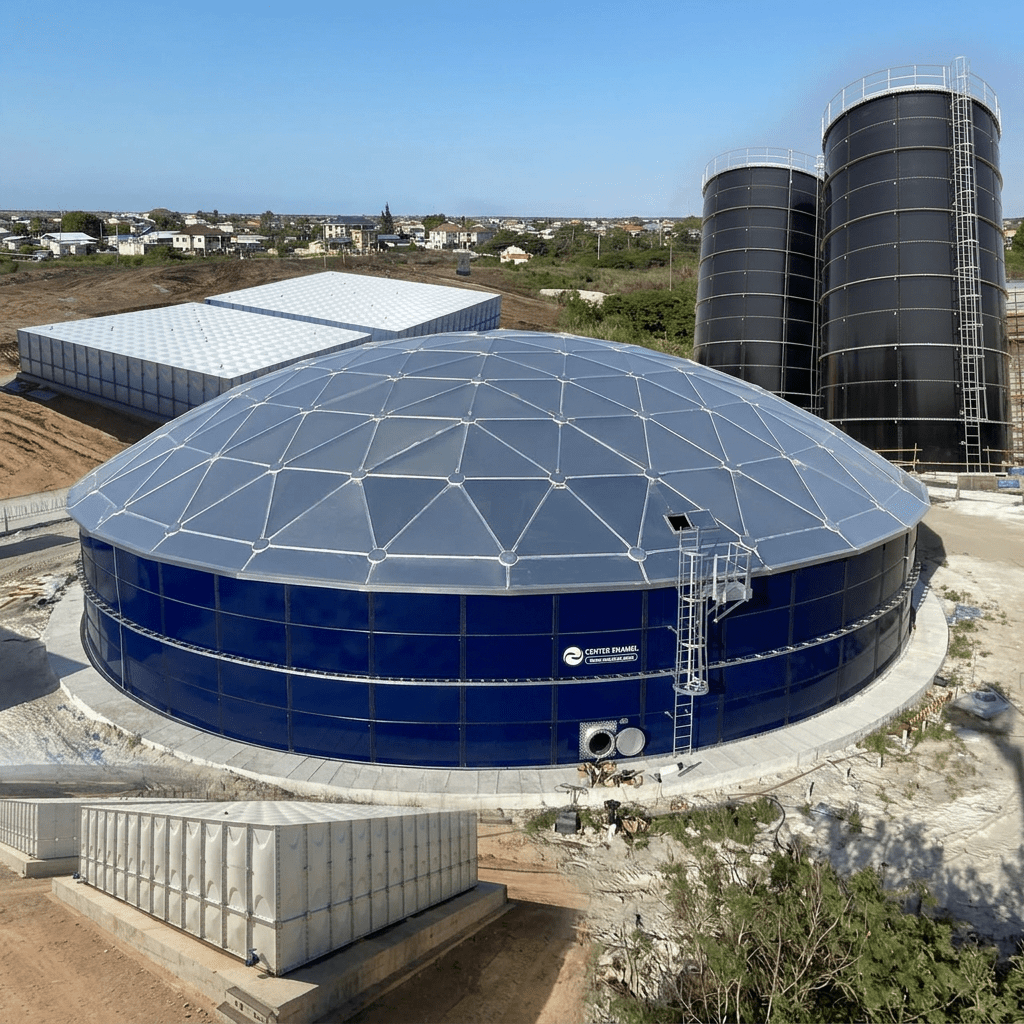
Agent for YHR and Santeks
GLS bolted tanks in Egypt
About the service
The right tank for the water, the site and the budget
Bolted tanks are made as factory-coated panels and assembled on site with bolts and sealant, so they go up faster than concrete or welded tanks and can be extended or relocated later.
Tank types we supply
- GLS (glass-fused-to-steel): potable water, wastewater, brine and fire water — long service life and high corrosion resistance.
- Epoxy-coated steel: an economical option for industrial and agricultural use.
- GRP sectional (panel) tanks: WRAS-approved fibreglass panels for drinking water and fire water — light enough to carry by hand into rooftops, plant rooms and basements.
GRP sectional tanks — supply and installation
We supply and install GRP sectional tanks: hot-pressed glass-reinforced panels bolted together on site into drinking-water and fire-water tanks of almost any size or shape. Each panel is compression-moulded from sheet moulding compound in a heated steel die, which is why the same panel carries WRAS approval for contact with drinking water up to 50 °C.
- WRAS approved panel material for drinking water, built to EN 13280 with CE and TSE conformity marks.
- About 50 years expected life — no corrosion, no painting and no internal lining.
- Opaque, UV-resistant panels keep light out, so algae cannot grow.
- Built on a 1 m grid, 1 m to 6 m high in 0.5 m steps — rectangular, L-shaped, U-shaped or around a column, and it can be split into two compartments so one side is cleaned while the other stays in service.
- Insulated panels available, with CFC-free polyurethane: 0.02 W/m·K through the wall against 43 for a steel panel — for rooftop tanks in hot weather.
- Panels carried by hand, so most tanks need no crane and fit where access is tight.
- Can be enlarged, relocated or partitioned later; panels are non-conductive and non-magnetic.
Ground-level tanks sit on a hot-dip galvanised base over concrete plinths; plant-room and basement tanks sit flat on a level slab. We pipe up, fill and leak-test every tank before handover. Download the GRP sectional tanks datasheet (PDF).
Agencies
Agent for YHR and Santeks GLS tanks in Egypt, with tank roofs from Vacono (Germany) and JSF (Spain).
Lifting jacks — made in Egypt
We manufacture our own GLS tank lifting jacks. That speeds up erection and lets us run several tanks in parallel.
Reference projects
- Two 16 m high GLS tanks for the water treatment plant at Lesaffre Egypt, New Nubaria, with Veolia — 2026
- GLS brine collection tank at the New Administrative Capital power plant, with Elsewedy Electric — 2022
- 500 m³ GLS tank for an Armed Forces water facility — 2020
Scope of work
From design to handover
Every stage is engineer-supervised and documented.
01
Selection and design
We review the water type, capacity and site, recommend the tank type and size, and prepare foundation drawings.
02
Supply
Panels, bolts, sealant and accessories direct from the manufacturer.
03
Erection with lifting jacks
Ring-by-ring erection to the manufacturer’s bolting sequence, with torque records.
04
Testing and handover
Hydrotest and handover of the operation and maintenance file.
FAQ
Questions about bolted water tanks
What is the difference between GLS, epoxy and GRP tanks?
GLS has the longest life and suits potable water, wastewater and brine; epoxy-coated steel costs less and suits industrial and agricultural use; GRP is lighter and insulated, and suits rooftops. We recommend a type once we know the water, capacity and site.
Do you erect tanks supplied by others?
Yes. We erect tanks the client bought from another supplier, working to the manufacturer’s assembly manual.
My tank is leaking or corroding — can you repair it?
Yes. We inspect on site, write a condition report, and repair leaks, corrosion, and failed sealant or coating — and we tell you honestly if the tank needs replacing.
What capacities are available?
Roughly 20 to 25,000 m³, depending on the type, diameter and height.
Do you work outside Egypt?
Yes. We provide erection supervision and lifting jacks for projects across the region.
What is a GRP sectional tank?
A GRP sectional tank is built on site from hot-pressed fibreglass panels on a 1 m grid, bolted together with sealing tape and braced with stainless steel tie rods. Heights run from 1 m to 6 m in 0.5 m steps, so the tank is sized to the room rather than the other way round.
Is GRP safe for drinking water?
Yes. The panel material is WRAS approved for contact with drinking water up to 50 °C, and tanks are built to EN 13280 with CE and TSE conformity marks. The panels are opaque and UV-resistant, so light cannot get in and algae cannot grow.
Can you install a GRP tank on a roof or in a basement?
Yes. GRP panels are light enough to be carried by hand, so most tanks need no crane and can be taken up stairs or through a doorway. Insulated panels are available for rooftop tanks in hot weather, and internally flanged tanks sit flat on a slab where headroom is short.
Do you supply GRP tanks only, or install them too?
Both. We supply the tank and erect it: plinths and galvanised base, panels and tie rods, roof, ladders and manhole, then piping, filling and a leak test before handover. We also repair and extend existing GRP tanks, whoever supplied them.